
Sweep AI

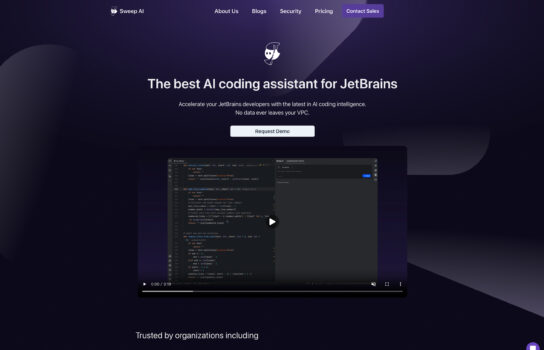
Sweep AI is an AI-powered automation tool designed for code maintenance, bug fixing, and development workflow optimization. Using machine learning and natural language processing (NLP) technology, it helps developers manage codebases more efficiently, automate code modifications, and speed up software development.
Our Verdict
What is Sweep AI
Sweep AI is an AI-powered developer assistant platform designed to automate and accelerate software development workflows. It reads your codebase, understands issues and feature requests, then generates pull requests (PRs) or code changes accordingly. Rather than just offering autocomplete, it aims to handle end-to-end tasks: from interpreting a ticket (“Fix bug X”) to producing a PR and running tests or type-hints. It’s particularly targeted at teams looking to reduce developer effort on repetitive or boilerplate coding tasks.
Is Sweep AI worth registering and paying for
if you’re a development team or organization that:
- Frequently deals with maintenance, bug-fixing, and minor feature changes,
- Has a codebase of sufficient size where automation yields meaningful time savings,
- Uses GitHub (or similar) and is comfortable with integrating AI into their workflow,
- And is willing to invest in reviewing/validating AI output rather than treating it as fully autonomous.
In these cases, the productivity gains and developer time savings can justify the cost. However, for individual developers, hobby projects, or teams that rarely do repetitive modifications, the ROI may be less clear — you might want to test the free tier (or open-source version) first.
In short: For professional, production-oriented teams, Sweep AI is likely worth paying for. For casual or one-off use, the free version might suffice, and you should evaluate cost vs benefit carefully.
Our experience
If you’re a developer who has ever stared at a mountain of tech debt tickets—like “add type-hints to all utility files” or “refactor this old logging function”—Sweep AI is the tool that makes your ears perk up. It’s not just a fancy autocomplete like the other assistants out there; it truly aims to be an autonomous junior developer for your repo.
The most human-like experience with Sweep comes from how you interact with it: you literally just open a GitHub issue (starting with a prefix like “Sweep:”) and describe the task in plain English, just like you would to a new intern. For example: “Fix the off-by-one error in data_loader.py that’s causing the last element to be missed.”
The Good: End-to-End Automation is Real
When Sweep works, it feels like magic. It reads your entire codebase, figures out where the relevant files are, writes a plan, implements the code fix, and opens a pull request with the changes, including running any tests or autoformatters.
- Routine Chore Slayer: Where it shines is with repetitive, boilerplate tasks. Things that are annoying to do but don’t require complex creative thought—adding tests, updating documentation, minor refactors. It saves you the context-switching headache. One user put it perfectly: “It’s like having a junior intern, except you can run 100 of them in parallel.”
- The PR Loop: I love that the entire workflow happens on GitHub. You don’t have to leave your environment. You review the PR it created, and if you leave a comment like “This line still needs a docstring,” it will actually go and try to fix its own PR and push a new commit. That iterative feedback loop feels incredibly powerful and is a huge step up from typical one-off code suggestions.
The Trade-offs: It Still Needs Adult Supervision
Sweep isn’t quite ready to handle architecturally complex features or logic bugs it hasn’t seen before.
- Complexity Wall: When you give it something that requires a deep, conceptual understanding of your business logic or a major architectural overhaul, it often gets confused, or the resulting PR is only 60-70% correct. You still have to spend time reviewing and guiding it. It’s not a senior engineer yet.
- The “Learning” Phase: You have to merge a few of its easier PRs for it to “learn” your codebase’s patterns and conventions. You have to invest that initial time to train it, but users who stick with it report accuracy going up significantly after a few weeks.
The Verdict
If you are a team with a heavy backlog of technical debt or small, well-defined feature tickets, Sweep is a massive productivity booster. It lets you focus on the hard, creative problems while the AI handles the grunt work. It truly shifts the developer’s role from writing every line of code to reviewing and guiding an autonomous assistant. It’s a compelling glimpse into the future of software development.