
Artificial Intelligence is becoming an essential skill across industries, from technology and business to education and design. As AI tools and applications continue to evolve, learning the basics is no longer optional—it’s a competitive advantage. The good news is that you don’t need to spend money to get started. Many reputable platforms now offer free AI courses created by leading universities and tech companies. These courses cover everything from AI fundamentals to machine learning and generative AI, making them suitable for beginners and professionals alike. Below are the top 10 free AI courses to help you upgrade your skills and stay future-ready.
HarvardX: CS50’s Introduction to Artificial Intelligence with Python
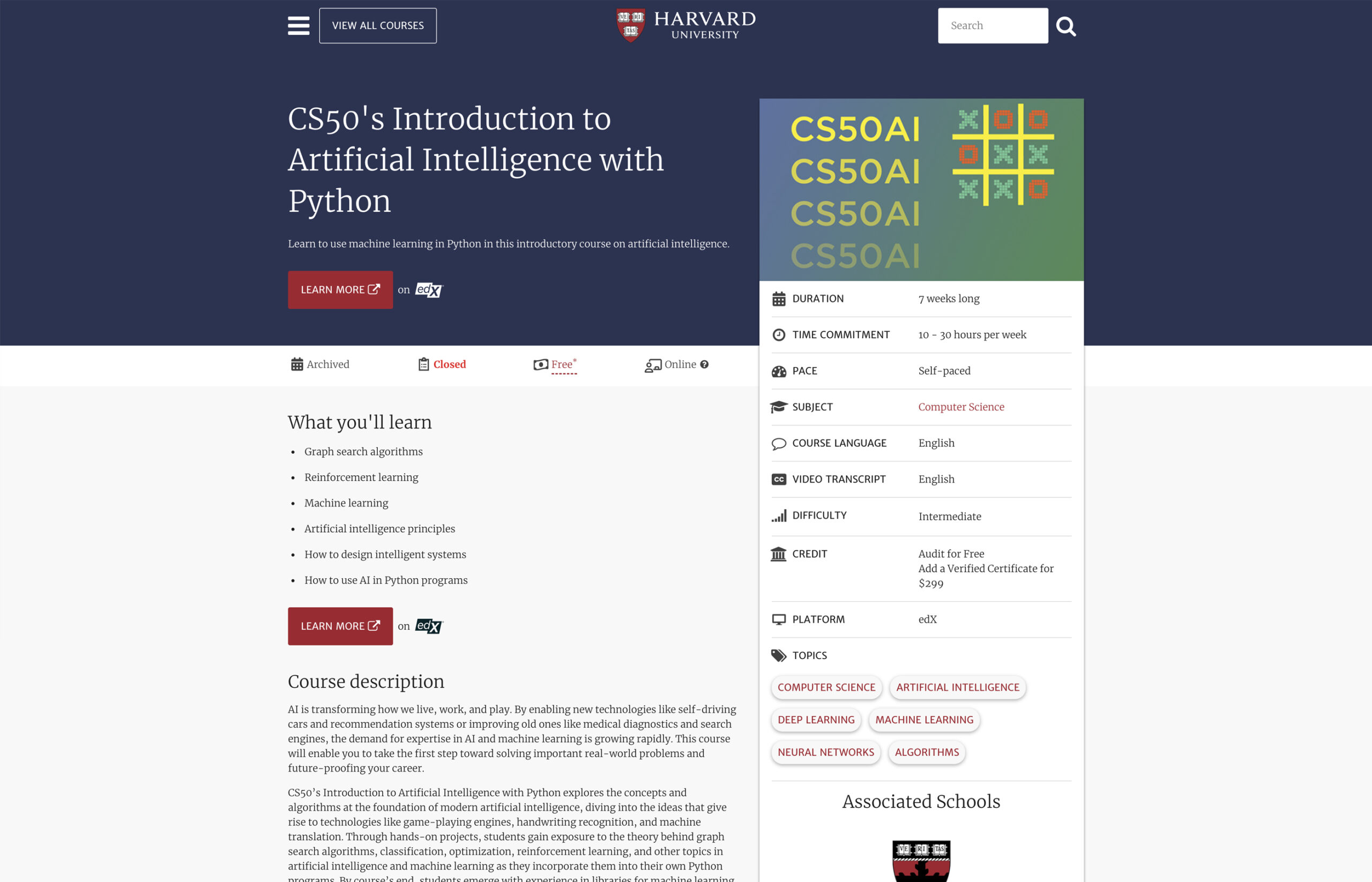
This free AI course is a part of Harvard’s renowned CS50 series. It introduces learners to the principles and technologies that drive modern AI, including knowledge representation, search algorithms, neural networks, and natural language processing. The course uses Python for practical assignments and is structured like a university-level course.
While the content is free to access, learners can choose to pay a small fee for a verified certificate. The course includes a series of lectures, hands-on projects, and problem sets that simulate real-world AI challenges. The final project allows learners to build an AI-based system from scratch.
This course assumes some prior experience with Python and programming fundamentals, but the instruction is clear and student-friendly. It’s designed for learners who are ready to move beyond beginner-level AI concepts and want a deeper academic challenge.
CS50’s AI track is praised for its clarity, rigor, and real-world applicability. Many participants use this course as a bridge to more advanced AI or machine learning training and value its association with Harvard’s computer science faculty.
Top Features:
- Taught by Harvard professors via edX
- Python-based hands-on projects and capstone
- Free to audit; certificate optional for a fee
- Strong academic credibility
Ideal for: Intermediate learners, aspiring developers, and students seeking university-quality AI education with hands-on coding.
Google – AI Courses Beginner: Introduction to Generative AI

An entry-level learning course created by Google to explain the fundamentals of generative artificial intelligence. The course introduces learners to what generative AI is, how it works at a high level, and where it is used in everyday products and industries. It is designed to be non-technical, making it easy for beginners with no prior AI or programming background to understand key concepts.
The course typically covers examples such as text generation, image creation, and content summarization, helping learners see how generative AI differs from traditional rule-based or predictive AI systems.
Top Features
- Beginner-Friendly Content – Uses simple language and real-world examples, no coding required
- Clear Explanation of Core Concepts – Explains generative AI, large language models (LLMs), and how AI is trained
- Practical Use Cases – Shows how generative AI is used in writing, design, customer support, and productivity tools
- Short and Structured Lessons – Easy-to-follow modules that can be completed quickly
- Google-Created Learning Material – Content reflects Google’s real-world AI applications and standards
Ideal for: beginners, students, and non-technical professionals who want a clear and simple introduction to generative AI. It is well suited for content creators, marketers, and business owners seeking to understand how AI tools generate text and images, as well as anyone curious about the real-world applications of generative AI without needing a technical background.
Microsoft – AI For Beginners Artificial Intelligence for Beginners – A Curriculum

Microsoft Artificial Intelligence for Beginners is a structured, open-source curriculum designed to introduce learners to the fundamentals of artificial intelligence. Created by Microsoft, the program provides a guided learning path that covers key AI concepts such as machine learning, neural networks, computer vision, and natural language processing. It combines theory with hands-on exercises, helping beginners build a solid understanding of how AI systems work and how they are applied in real-world scenarios.
The curriculum is suitable for self-study and classroom use, gradually progressing from basic concepts to practical implementations.
Top Features
- Beginner-to-Intermediate Learning Path – Starts with core AI concepts and builds toward applied skills
- Hands-On Labs and Exercises – Practical activities using Python and popular AI libraries
- Modular Curriculum Structure – Lessons are organized into clear, topic-based modules
- Open-Source and Free – Publicly available and easy to access
- Real-World AI Topics – Covers machine learning, computer vision, NLP, and ethical AI
- Microsoft Ecosystem Support – Examples and tools aligned with Microsoft technologies
Ideal For
- Students and Self-Learners beginning their journey into artificial intelligence
- Aspiring Developers and Data Scientists who want a strong AI foundation
- Educators and Instructors looking for a ready-to-use AI teaching curriculum
- Beginners with Basic Programming Knowledge, especially in Python
- Learners Planning to Advance to more specialized AI or machine learning courses
DeepLearning.AI

This short course, created by DeepLearning.AI in collaboration with OpenAI, teaches prompt engineering using ChatGPT. It’s designed to help developers and technical professionals write effective prompts for AI models, particularly large language models (LLMs). The course is free, includes hands-on labs, and is hosted on the DeepLearning.AI platform.
The curriculum focuses on practical use cases like summarization, classification, and transformation using OpenAI’s API. You’ll learn how to guide the model’s output, design prompts for reliability, and integrate prompt techniques into software applications. No formal certificate is issued, but the course can be completed in under two hours, making it a high-value, fast-paced introduction to prompt design.
This course assumes some technical background and familiarity with Python. While it’s not meant for total beginners, it’s approachable for product managers, engineers, or developers already experimenting with ChatGPT or GPT-based tools.
Because it’s taught by Andrew Ng and his team, the content is structured, efficient, and grounded in real developer workflows. It’s one of the most practical introductions to prompt engineering currently available for free.
Top Features:
- Created by DeepLearning.AI in partnership with OpenAI
- Focus on prompt design and integration into applications
- Quick, high-impact learning format
- Hands-on examples and real use cases
Ideal for: Developers, engineers, and product managers exploring prompt engineering and LLM-based AI applications.
LinkedIn Generative AI Online Training Courses

LinkedIn Generative AI Online Training Courses are a collection of video-based learning programs offered on LinkedIn Learning that teach learners about generative artificial intelligence (Gen AI), large language models, and related AI technologies. These courses range from introductory classes that explain what generative AI is and how it works, to more specialized topics like prompt engineering, AI tools, and using generative AI in specific professional contexts. They are designed to help individuals understand AI concepts, develop practical skills, and earn certificates they can share on their LinkedIn profiles.
Top Features
- Wide Selection of Courses – Covers many generative AI topics including basic definitions, LLMs, prompt engineering, and practical applications in business and marketing.
- Flexible, On-Demand Learning – Courses are video-based and self-paced so learners can study anytime via desktop or mobile.
- Certificates of Completion – Learners earn shareable certificates to add to LinkedIn profiles and resumes.
- Skill-Level Variety – Includes beginner courses for those new to AI as well as more advanced or applied training for professionals.
- Professional Context Focus – Some courses tailor AI learning to specific fields like marketing or business strategy.
- Integrated with LinkedIn Ecosystem – Skills learned can be directly showcased to recruiters and peers on LinkedIn.
Ideal For
- Beginners in AI who want a gentle introduction to generative AI concepts.
- Professionals and Marketers seeking to apply generative AI tools in their work.
- Career Builders looking to enhance their LinkedIn profiles with AI credentials.
- Students and Lifelong Learners interested in future-focused tech skills.
- Teams and Organizations wanting structured AI training for employees.
DeepLearning AI × OpenAI

This short course, created by DeepLearning.AI in collaboration with OpenAI, teaches prompt engineering using ChatGPT. It’s designed to help developers and technical professionals write effective prompts for AI models, particularly large language models (LLMs). The course is free, includes hands-on labs, and is hosted on the DeepLearning.AI platform.
The curriculum focuses on practical use cases like summarization, classification, and transformation using OpenAI’s API. You’ll learn how to guide the model’s output, design prompts for reliability, and integrate prompt techniques into software applications. No formal certificate is issued, but the course can be completed in under two hours, making it a high-value, fast-paced introduction to prompt design.
This course assumes some technical background and familiarity with Python. While it’s not meant for total beginners, it’s approachable for product managers, engineers, or developers already experimenting with ChatGPT or GPT-based tools.
Because it’s taught by Andrew Ng and his team, the content is structured, efficient, and grounded in real developer workflows. It’s one of the most practical introductions to prompt engineering currently available for free.
Top Features:
- Created by DeepLearning.AI in partnership with OpenAI
- Focus on prompt design and integration into applications
- Quick, high-impact learning format
- Hands-on examples and real use cases
Ideal for: Developers, engineers, and product managers exploring prompt engineering and LLM-based AI applications.
Kaggle — Intro to Machine Learning and AI Micro-Courses

Kaggle, the online data science competition platform, offers a series of free AI and machine learning micro-courses that focus on practical skills used in real data science projects. These micro-courses include “Intro to Machine Learning,” “Intermediate ML,” “Deep Learning,” and more.
The courses are interactive and browser-based, which means learners can write and execute code in a notebook interface directly from the web, no installation required. They cover essential topics like decision trees, model validation, pipelines, and deep neural networks, all using Python and popular libraries such as scikit-learn and XGBoost.
There’s no official certificate offered, but Kaggle profiles and completed course badges are recognized by the data science community and can be showcased publicly. These micro-courses are designed for learners who want fast, no-fluff instruction with code-first applications.
Because they’re modular, learners can start at any level and progress to more advanced topics at their own pace. This makes them perfect for professionals looking to acquire practical AI skills quickly.
Top Features:
- Interactive, code-first courses in-browser
- Focus on practical tools like scikit-learn and XGBoost
- Community-driven learning with leaderboard incentives
- Free access to datasets and kernels
Ideal for: Aspiring data scientists, machine learning enthusiasts, and professionals looking for practical project-based AI learning without theory overload.
Elements of AI— Free AI course by University of Helsinki

The Elements of AI is a globally recognized, free AI course created by the University of Helsinki in collaboration with the Finnish tech company Reaktor. It’s aimed at making artificial intelligence more understandable and accessible to the general public, regardless of professional or academic background. The course has been translated into over 20 languages and has been taken by hundreds of thousands of learners worldwide since its launch.
Structured into six modules, the course covers key areas such as the definition of AI, neural networks, machine learning, and real-world implications of algorithmic decision-making. It combines short readings, multiple-choice questions, and short-answer tasks to reinforce learning and ensure learners can apply what they’ve understood. There are no videos or coding exercises, making it ideal for learners who prefer reading-based content and theoretical learning.
While it doesn’t include coding or highly technical materials, the Elements of AI still manages to communicate many of the essential concepts in AI, including its limitations and ethical considerations. It places particular emphasis on how AI affects society and individual lives, making it especially valuable for policymakers, business leaders, and students in social sciences or humanities who are looking to enter the AI conversation without needing to program.
Upon completion, learners receive a certificate co-signed by the University of Helsinki. This certificate can be shared on LinkedIn or resumes, and while not as credentialed as a university degree, it holds respect in professional and educational communities due to its academic backing and widespread usage.
Top Features:
- Created by University of Helsinki and Reaktor
- Available in over 20 languages
- Entirely free with certificate
- Non-technical, theory-focused learning
Ideal for: Curious learners from non-technical backgrounds, policymakers, educators, and professionals interested in the societal implications of AI.
AWS – Foundations of Prompt Engineering

The Machine Learning Foundations Course from AWS, in partnership with Udacity, is a free online program created to introduce learners to the core concepts of AI and ML. Originally part of AWS’s scholarship program, this course remains available to the public for free and includes hands-on labs, quizzes, and video instruction.
The content includes supervised learning, unsupervised learning, linear regression, and neural networks. It’s meant to provide foundational ML understanding before progressing to more advanced topics or paid nanodegrees. Learners use AWS’s cloud-based tools and environments, which helps develop practical skills in managing ML projects on enterprise-grade platforms.
Although the course itself doesn’t issue a certificate unless taken through a scholarship cohort, it’s still valued as a stepping stone into AWS’s broader machine learning certification path. Those who complete the course often continue into paid credentials like the AWS Certified Machine Learning – Specialty exam.
This course is ideal for learners interested in gaining experience with Amazon’s ecosystem while developing real-world ML skills through cloud infrastructure.
Top Features:
- Co-developed by AWS and Udacity
- Real-world AWS environment exposure
- Strong foundation for further AWS certification
- Free for self-paced learners
Ideal for: Technologists and developers exploring ML with cloud platforms, especially those intending to pursue AWS certification paths.
Oxford Home Study — Free AI courses

Oxford Home Study Centre (OHSC) offers completely free online courses in Artificial Intelligence that serve as a basic introduction to the field. Unlike university-backed programs, OHSC operates as a private distance learning provider, yet it has gained attention for its accessible, no-cost courses that come with the option to purchase a certificate of completion. The AI course introduces foundational concepts without overwhelming learners with complex technical material.
These courses consist of several modules covering the definition of AI, key use cases, major types of AI systems, and a brief overview of historical developments. It is designed for self-paced learning and is accessible immediately upon enrollment without any prerequisites. Although relatively brief, it aims to provide learners with enough background to make sense of AI discussions in business and media contexts.
While the learning experience is largely text-based and lacks interactivity, it’s ideal for learners looking to gain a basic understanding of AI without any pressure. It is not a suitable course for those looking for hands-on skills, coding projects, or real-world application training. However, for absolute beginners who want a free and quick introduction, it offers a low-friction starting point.
Upon completion, students can opt to pay a small fee to receive an official certificate of completion from OHSC. This is optional, and the core course content remains entirely free. The certificate is not academically accredited but can be a confidence booster or stepping stone toward more in-depth learning.
Top Features:
- 100% free enrollment and study access
- Simple, beginner-friendly written content
- Optional low-cost certificate available
- No prerequisites or time limits
Ideal for: Learners seeking a casual, entry-level overview of AI with zero cost and no pressure to complete assignments
