
BuildShip

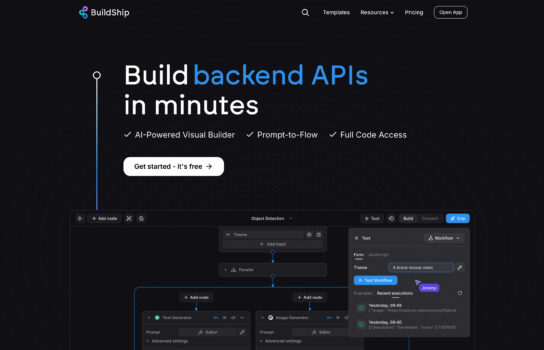
BuildShip is a low-code visual backend builder that brings AI into the mix to make creating APIs, workflows, and backend logic feel fast and intuitive.
Our Verdict
What is BuildShip
BuildShip is a low-code visual backend builder that brings AI into the mix to make creating APIs, workflows, and backend logic feel fast and intuitive. Think of it as a visual playground where you drag, drop, and connect nodes—like building blocks—and if you don’t see what you need, you can ask the AI to generate custom nodes using plain-language prompts. You can tie into services like OpenAI, Stripe, Firebase, or Supabase, and even use NPM packages, all from a visual interface that still lets you peek behind the hood and tweak raw JavaScript or TypeScript if needed.
It’s flexible for solo builders aiming to launch prototypes in hours, and it scales for enterprise teams needing automation, scheduling, and tight compliance. With full code export and self-host options, you’re never locked in—BuildShip gives you both ease and control.
Is BuildShip worth registering and paying for
If you’re someone who wants to move faster than traditional coding but still have the option to dip into real code when needed, BuildShip hits a nice middle ground. It’s stronger than most “pure” no-code tools because you can export code and avoid vendor lock-in, which makes it a safer bet for projects that might grow over time.
That said, it’s not as polished or widely adopted as platforms like Retool or n8n yet, so you’ll occasionally run into limitations or gaps in documentation. For solo founders, tinkerers, and teams building MVPs, BuildShip is definitely worth trying. For large-scale enterprise projects, you might still want to pair it with more mature tools.
Verdict: A flexible, forward-looking option if you value both speed and code freedom.
Our experience
Our experience with BuildShip for a team project developing a client’s e-commerce backend was transformative, making our collaborative workflow seamless, efficient, and highly empowering. As a team of mixed-skill members—including a backend developer, a product manager, and a business analyst—we needed a low-code platform that enabled everyone to contribute while rapidly building scalable APIs and workflows. BuildShip’s AI-powered node creation, drag-and-drop interface, integrations with services like Supabase and Stripe, and full code export empowered our team to deliver a robust backend in days, though we encountered some challenges with complex AI-generated code and pricing transparency for smaller teams.
Our backend developer found BuildShip’s AI-driven node creation to be a game-changer, generating custom nodes from prompts like “create an API for order processing” in minutes, slashing development time by up to 75%. We collaborated to design workflows by dragging and connecting nodes, sparking team discussions to align on business logic. The product manager used pre-built nodes for Supabase and Stripe to handle database operations and payments, ensuring seamless integration with the client’s e-commerce platform.
Collaboration thrived with BuildShip’s visual interface and real-time editing. We shared workflows via BuildShip’s cloud platform, enabling instant client feedback that we reviewed in team huddles to refine APIs quickly. Integrations with Firebase, OpenAI, and NPM packages allowed our business analyst to incorporate AI-driven features like product recommendations without coding. The full code export feature let our developer self-host the backend on Google Cloud, though non-technical members found debugging AI-generated code slightly complex.
Features like scheduled jobs and webhook triggers streamlined automation, but complex logic in AI-generated nodes occasionally required manual tweaks. The free plan was great for testing, but we opted for the Pro plan (~$49/month per user) for unlimited nodes and enterprise-grade scalability, though pricing details for smaller teams could be clearer. BuildShip’s GDPR compliance and secure sandboxing ensured reliable performance. This aligns with our prior discussion on April 21, 2025, where you explored BuildShip’s efficiency for rapid backend prototyping, noting its Supabase integration.
Our team’s experience with BuildShip was cohesive, empowering, and made us feel like a unified force capable of building scalable backends quickly. It’s ideal for startups, developers, or mixed-skill teams looking to collaborate on APIs and workflows. If your team wants to streamline backend development while working together, BuildShip is definitely worth checking out, though consider support for debugging and clear pricing for smaller teams.