Descript

Descript is a tool highly suited for individuals who frequently need to edit video content. It combines the functionalities of a video editor and a word processor, making video production simpler and more efficient.
Our Verdict
What is Descript
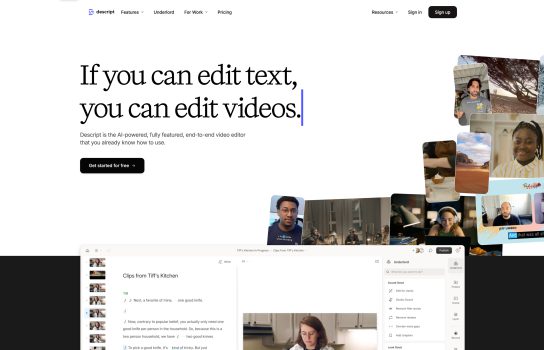
Descript is an AI-powered all-in-one audio and video editing platform that redefines how creators edit media. Its most innovative feature — text-based editing — allows users to edit videos and podcasts as easily as editing a document. You can cut, correct, or rearrange video and audio simply by modifying the transcribed text.
With features like automatic transcription, AI voice cloning (Overdub), studio-grade sound enhancement, and real-time collaboration, Descript is ideal for podcasters, YouTubers, educators, and marketing teams who need to produce professional content quickly.
It also includes advanced AI tools such as filler word removal, green screen replacement, and AI assistant (Underlord) to streamline the production process even further.
Is Descript worth registering and paying for
Descript is absolutely worth it for creators, podcasters, educators, and businesses focused on efficient and professional content production. Its ability to edit via text, remove filler words, and enhance audio makes it a game-changer compared to traditional editing tools.
If your workflow involves frequent editing of video interviews, podcasts, or tutorial content, Descript can drastically cut production time while maintaining professional quality. However, if you need advanced cinematic effects or heavy visual editing, pairing it with a specialized video editor might be necessary.
Our experience
Honestly, Descript is the most genuinely revolutionary tool I’ve used for content creation in years. It changes the game entirely, especially if you’re a podcaster, an educator, or a YouTuber focused on dialogue.
The Magic: Text-Based Editing is a Time Machine
The text-based editing isn’t just a gimmick; it’s a productivity superpower. In traditional video or audio software, cutting out a clumsy sentence means scrubbing a timeline, finding the exact start and end of the waveform, and hoping you didn’t clip a breath. With Descript, you just delete the words in the transcript. It’s as fast as editing a Google Doc.
This is a lifesaver for long interviews or webinars. I can read the transcript faster than I can listen to the audio, meaning my first “paper edit” where I cut out all the irrelevant rambling is done in a fraction of the time. This feature alone makes the subscription worth it.
The AI Assistants: Mostly Brilliant, Sometimes Too Eager
The AI features are the secret sauce for making me sound like a pro:
- Filler Word Removal: This is a one-click wonder. It finds every “um,” “uh,” and “you know” and deletes them. You’ll want to check its work because sometimes it gets a little aggressive and cuts a natural pause, but it transforms a hesitant speaker into a confident one in seconds.
- Studio Sound: This is pure sorcery. Record in a noisy kitchen on a cheap mic, hit the Studio Sound button, and suddenly you sound like you’re in a padded studio. It strips away background noise and echo, giving the audio a crisp, professional presence. It can occasionally sound too processed or “robotic” on very poor source audio, but 9 times out of 10, it’s incredible.
- Overdub (AI Voice Cloning): This is for minor fixes, and it’s fantastic. I’ll mispronounce a name or use the wrong word, and instead of re-recording the entire sentence, I just type the correction. Descript inserts the new word in my cloned voice. For a few words, it blends in seamlessly. For longer, more emotional sentences, it can sound a bit flat, but for quick clean-up, it’s a massive time-saver.
Where the Shine Fades: The Real-World Friction
I have to be honest: the experience isn’t flawless, and this is where you’ll hear the most complaints from long-time users:
- Stability is a Concern: This is the biggest sticking point. When dealing with large, complex projects, Descript can get slow, laggy, and occasionally crash. You’re working on the desktop app, but it’s heavily cloud-dependent, and that can lead to frustrating moments where you lose a few minutes of work or have to wait for it to resync.
- Not a Traditional Video Editor: If you’re coming from Premiere Pro or Final Cut, the text-based workflow can feel clunky for highly visual edits. Doing complex color grading, multi-layer VFX, or simple, precise cuts that don’t align perfectly with the transcript can be a real pain compared to a dedicated timeline editor. It’s an amazing dialogue editor but not a top-tier visual editor.
- Export Quality: A few users have noted that the export compression, even at the highest settings, can sometimes degrade video quality more than other professional software. This is something to keep an eye on, especially if you prioritize high-fidelity 4K video.
Final Verdict
Descript is a groundbreaking tool that has fundamentally changed my workflow. For anyone creating podcasts, YouTube videos, or educational content driven by spoken word, it’s a must-have. It democratizes professional editing, allowing people who have no interest in learning a complex timeline to produce a polished, high-quality final product.
It’s the ultimate tool for getting your message out fast and sounding great, even if you have to tolerate the occasional bug or rely on another piece of software for heavy visual effects. The time it saves me editing dialogue easily outweighs its occasional quirks.