
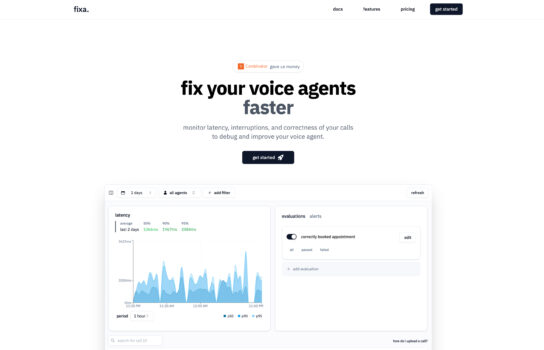
Fixa

Fixa is an AI voice agent testing and observability platform. Simply put, it’s a tool designed specifically for developers and companies working with AI voice assistants like Siri, Alexa, and more.Fixa is an AI voice agent testing and observability platform. Simply put, it’s a tool designed specifically for developers and companies working with AI voice assistants like Siri, Alexa, and more.
Our Verdict
What is Fixa
Fixa is an AI voice agent testing and observability platform designed for developers, QA teams, and companies working with AI-powered voice assistants such as Siri, Alexa, Google Assistant, and custom voice bots.
Fixa enables users to simulate, monitor, and analyze how voice agents perform in both development and production environments. By providing deep insights into response accuracy, latency, user experience, and system reliability, Fixa helps teams build and maintain high-performing, natural-sounding voice experiences.
With tools for real-time monitoring, debugging, and collaborative analysis, Fixa bridges the gap between development and deployment—ensuring your voice assistant works flawlessly across all use cases and devices.
Is Fixa worth registering and paying for
If you’re building, maintaining, or scaling AI voice assistants or conversational AI products, Fixa is absolutely worth registering and paying for. Its combination of testing automation, real-time observability, and performance analytics makes it a powerful asset for ensuring your voice agent delivers a smooth and reliable user experience.
For voice tech startups, enterprise developers, or teams managing multiple AI assistants, Fixa can significantly improve efficiency, reduce bugs, and enhance user satisfaction—making it a strong investment.
However, for individual hobbyists or small experiments, the platform may offer more than you need, and the free or trial tier might be sufficient for exploration.
Our experience
As a developer or QA specialist, the moment you move a cool, custom AI voice agent from your clean sandbox environment into the chaos of production, the actual fun—and the real stress—begins. That’s where a tool like Fixa becomes less of a luxury and more of an absolute necessity.
Here’s my take on the experience:
The Problem Fixa Solves: The ‘Real-World’ Breakdown
When you build a voice bot using Google Assistant or a custom solution, it sounds great in your office. But in production, you deal with a customer calling from a busy bus, an elderly user with a heavy accent, or a system bug that causes a 5-second silence mid-call. These moments are where the user experience completely falls apart, and traditional monitoring tools don’t catch it.
Fixa is explicitly designed for those fragile moments. It’s not just looking for a server crash (your basic APM tool does that); it’s looking for the conversational failures that drive customers insane.
The Good: Seeing the Invisible
- Latency, Latency, Latency: The most critical feature is the deep dive into latency. Human conversations are natural when the response time is under a second. Fixa doesn’t just give you an average; it shows you P50, P90, and P95 latency metrics. I can immediately see if 5% of my users are experiencing a 3-second delay (the P95), which is the exact point customers hang up. This data lets me go straight to the component—the ASR, the LLM, or the TTS—that’s dragging the whole conversation down.
- The Interruption Detector: This is huge. One of the most awkward things an AI can do is talk over the user or cut them off. Fixa’s Interruption Detection automatically flags these “talking over” moments in production calls. It allows my QA team to fine-tune the Voice Activity Detection (VAD) model to listen better and create a truly natural, human-style conversational flow. You can’t optimize for this if you can’t measure it.
- Accuracy Testing with an ‘AI Judge’: Setting up custom evaluations is extremely powerful. Instead of just checking if the code ran without error, Fixa lets me set up an “AI Judge” (often an LLM) to check if the outcome was successful. For example: “Did the agent successfully confirm the user’s order number and reschedule their appointment?” This bridges the gap between technical success and business success.
The Developer Experience
For the development team, Fixa is a relief. When a customer calls in with an issue, we can instantly pull up the full, reconstructed conversation transcript, see a timeline trace of the latency at every single turn (transcription time, model processing time, synthesis time), and pinpoint the exact moment the conversation went off the rails. It’s the difference between guessing what went wrong and knowing what went wrong in milliseconds.
The fact that it’s open-source for its core testing packages and built on modern observability principles means it fits right into a modern DevOps pipeline. It feels like a tool built by voice developers, for voice developers.
Final Verdict
If you’re serious about your AI voice agent being an asset instead of a liability, you need an observability platform like Fixa. It stops focusing on “did the server crash?” and starts focusing on the metric that actually matters: “Did the customer have a good conversation?” It gives you the deep, conversational-specific telemetry required to ship a voice agent that feels polished, reliable, and genuinely human.