
Stable Audio

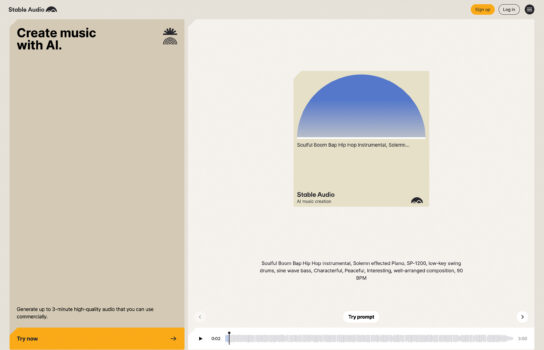
Stable Audio is an AI music generation tool developed by Stability AI, known for creating the image generation model Stable Diffusion. It allows users to generate original music by simply entering a text description, leveraging AI technology to automatically create music that fits the user’s needs.
Our Verdict
What is Stable Audio
Stable Audio is an AI-powered music generation tool developed by Stability AI, the same company behind the groundbreaking image model Stable Diffusion. It enables users to create original, royalty-free music simply by typing a text description. Whether you need background music for a video, podcast, game, or ad, Stable Audio turns words into high-quality soundtracks in minutes—no musical expertise required.
The tool uses advanced deep learning models trained on professionally produced music, allowing it to generate compositions with realistic instruments, rhythm, and structure that align with your prompt.
Is Stable Audio worth registering and paying for
If you regularly create video content, podcasts, ads, or indie games, Stable Audio is definitely worth trying. The paid version offers longer, higher-quality tracks, faster processing, and full commercial rights—all valuable for professional creators.
However, if you only need music occasionally or prefer full creative control over every instrument, the free tier or other traditional royalty-free libraries might be enough.
Our experience
I’ve been waiting for a tool like Stable Audio, and honestly, it mostly delivers on the hype. As someone who constantly needs background music for videos and podcasts, the “royalty-free in minutes” pitch is pure gold. Nobody has time to sift through stock music libraries for hours, and commissioning a composer is often out of budget.
The Experience: Text to Tune
Getting started is exactly what you’d expect from an AI tool. You type what you want, hit “generate,” and a few moments later, you get a track. It’s like Midjourney, but for your ears.
What I Loved (The Pros):
- The Quality is Legitimately High: This is where Stable Audio shines. Unlike some earlier AI music generators that sounded thin, muffled, or just… weird, the tracks from Stable Audio are high-fidelity (44.1 kHz, which is CD quality). The instruments sound realistic—the drums have a punch, the synths are warm, and the strings don’t sound like a cheap keyboard preset. This is the first AI I’ve used where the output is genuinely mix-ready for professional video work.
- Excellent for Background/Ambient Tracks: If you need a specific, niche background bed—say, a “lo-fi hip-hop beat with a driving synth and a vinyl crackle, 85 BPM, dark and chill mood”—it nails it. The level of detail you can put into the prompt really dictates the quality of the output, and it handles genre blending surprisingly well.
- Structure is Improving (Especially in 2.0+): Older versions had a problem with coherence, often sounding like a nice 30-second loop just awkwardly extended. The newer models are getting much better at creating a proper intro, development, and outro, making the tracks instantly more usable for a 1- or 3-minute video segment.
- Royalty-Free and Licensed Training: This is the most crucial part for commercial use. The fact that the model was trained on a licensed dataset (like AudioSparx) and offers clear commercial rights (on paid plans) means I can use it without the constant fear of a surprise copyright strike down the line. That peace of mind is worth the subscription cost alone.
What Needs Work (The Cons):
- Complex Arrangements & Vocals: If you ask it for a full-blown “epic orchestral rock song with soaring female vocals and a guitar solo,” it’s going to struggle. It excels at instrumental beds, but the human-style vocals, if they appear at all, can sound synthetic and a bit unsettling. For anything with a lead melody or complex human emotion, you still need a human composer.
- The Prompt Game is Real: Just typing “happy music” will get you a generic, often underwhelming result. To get the magic, you have to become a prompt engineer. You need to specify genre, mood, tempo (BPM), instrumentation (“no woodwinds,” “clean electric guitar”), and even mixing style (“reverberated drums,” “close-mic’d bass”). It takes a few tries to learn the AI’s language.
- Control is Still Limited: While you can ask for a specific duration, you can’t tell it where the hook or the climax should happen in the same way you can in a Digital Audio Workstation (DAW). It’s still a black box—you input text and hope for the best, with limited ability to tweak the result without regenerating entirely.
Final Verdict
Stable Audio isn’t going to replace an album-grade music producer, but for content creators, podcasters, game developers needing ambient loops, and marketers needing custom ad beds, it’s an absolute productivity multiplier. It turns what used to be a tedious, expensive task into a fast, affordable creative exercise.
If you are constantly struggling to find the perfect royalty-free track that matches your video’s exact mood and duration, Stable Audio is a must-try. Just be ready to put on your composer’s hat and get specific with your text prompts. The future of background music is here, and it’s surprisingly good.