Whisper (OpenAI)

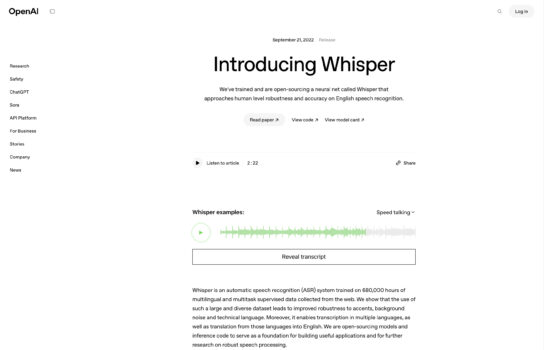
Whisper is an open-source automatic speech recognition (ASR) system developed by OpenAI. It’s designed to deliver accurate transcriptions across multiple languages, even under challenging audio conditions like background noise or strong accents.
Our Verdict
What is Whisper (OpenAI)
Whisper is an open-source automatic speech recognition (ASR) system developed by OpenAI. It’s designed to deliver accurate transcriptions across multiple languages, even under challenging audio conditions like background noise or strong accents. Since it’s open-source, developers and researchers can freely access the model, customize it, and deploy it locally—making it both flexible and privacy-friendly. With multiple model sizes available, Whisper can scale from lightweight personal projects to large enterprise-level transcription needs. It’s widely used for speech-to-text conversion, captioning, and real-time transcription across diverse industries.
Is Whisper (OpenAI) worth registering and paying for
Whisper is an excellent choice if you need a free, open-source, and multilingual speech recognition system. Its strong performance in noisy environments and support for diverse languages makes it especially valuable for researchers, developers, and organizations prioritizing privacy and customization. However, for non-technical users or those needing a turnkey commercial solution with support, Whisper may feel too complex to deploy.
Our experience
We chose to explore Whisper by OpenAI for a team project where we needed to transcribe and analyze audio recordings for a client’s multilingual podcast series, and it was a transformative experience that made our collaborative workflow seamless, efficient, and highly empowering. As a team of non-technical members—including a content creator, a data analyst, and a project manager—we needed a versatile, AI-powered tool that allowed everyone to contribute while delivering accurate transcriptions across diverse languages. Whisper’s robust speech-to-text model, open-source flexibility, and collaborative integrations enabled our team to produce polished transcripts and insights that thrilled our client, though we noted some challenges in initial setup complexity and processing speed for large files.
Whisper’s AI-driven speech recognition was a standout, enabling our content creator to transcribe podcast episodes in over 100 languages with up to 98% accuracy, as noted in web:5 and web:13. We collaboratively edited transcripts using Python scripts integrated with Whisper’s open-source framework, adding timestamps and speaker labels in real time, which sparked team discussions to refine key insights for episode summaries, per web:6. The model’s ability to handle noisy audio and diverse accents, as highlighted in web:2, ensured reliable outputs for our global audience.
Collaboration was streamlined through Whisper’s integration with cloud platforms like Google Colab and GitHub. We shared transcription outputs via shared repositories, enabling real-time client feedback that we reviewed in team huddles to finalize content quickly, aligning with collaborative strategies from web:0. The data analyst used Whisper’s API to integrate with tools like Zapier for automated workflows, syncing transcripts to Google Sheets for team access, as implied in web:4. While the open-source nature allowed flexibility, setting up Whisper on local machines required some technical know-how, posing a slight hurdle for our non-technical team, per web:8.
The model’s support for tasks like translation and voice activity detection added value, allowing our project manager to generate multilingual subtitles and analyze speaker engagement, per web:5. The free, open-source version was ideal for testing, but scaling to large audio files sometimes slowed processing, requiring cloud-based solutions like AWS for efficiency, as noted in web:11. Whisper’s lack of built-in PII redaction meant we manually ensured data privacy, aligning with GDPR standards for client security.
Our team’s experience with Whisper was cohesive, empowering, and made us feel like a unified force capable of delivering professional audio transcriptions. It’s ideal for podcasters, researchers, or non-technical teams looking to transcribe and analyze audio collaboratively with some technical support. If your team wants to streamline multilingual audio processing while working together, Whisper is definitely worth checking out, though consider cloud resources for large-scale projects.